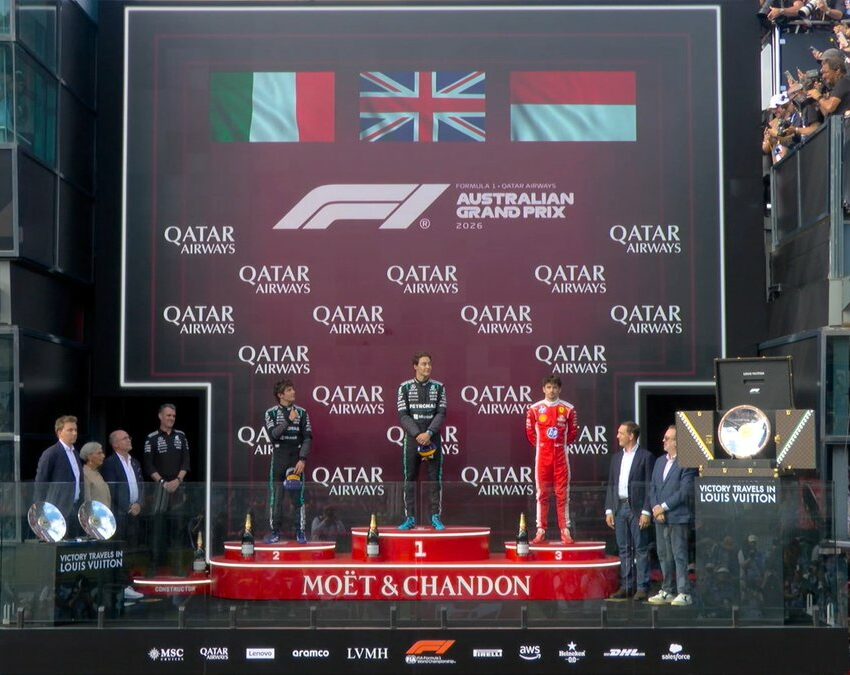
Mercedes make a statement in Melbourne
The 2026 Australian Grand Prix was never going to be a quiet affair. A new rulebook, new technology, fresh rivalries and unanswered questions had been building all summer. By Sunday evening at Albert Park, one thing was clear. Mercedes arrived ready.
George Russell led home team mate Kimi Antonelli in a commanding 1-2 finish that immediately positions the Silver Arrows as the benchmark in Formula 1’s new era. It was not straightforward. It was not comfortable. But it was clinical.
After locking out the front row in qualifying, Mercedes had already sent a message. Still, race day in Melbourne is rarely predictable, and the opening laps proved exactly that.
Read more: Be the first to know – Join our WhatsApp channel for content worth tapping into. Click here to join!
Ferrari show early fire
Charles Leclerc wasted no time reminding everyone that Ferrari intend to fight. Launching from fourth on the grid, the Monegasque driver snatched the lead from Russell into Turn 1, turning the grandstands red with excitement. Lewis Hamilton was right there too, applying pressure in the opening exchanges.
For a few laps, it looked like Ferrari had stolen the momentum. Leclerc and Russell traded the lead in an intense early duel that showcased the new era’s added electrical power and overtaking features. The extra battery deployment created thrilling wheel-to-wheel moments that had fans on their feet.
But strategy became decisive.
Two Virtual Safety Car periods presented opportunities. Mercedes reacted immediately, bringing both cars in early. Ferrari chose to stay out. When the Scuderia eventually pitted, the time loss proved costly. Track position slipped away.
Leclerc still salvaged a podium, finishing third, while Hamilton came home fourth. Encouraging pace was evident, but the execution edge belonged to Mercedes.
Read more: Lewis Hamilton reveals there will be a sequel to F1: The movie
Russell and Antonelli rise to the occasion
Russell controlled the race when it mattered most. Once back in front, he managed his tyres with precision, stretching the stint to the chequered flag despite the looming threat of a second stop.
Antonelli’s drive was equally impressive. After dropping to seventh at the start, the young Italian regrouped, carved through the field and secured second place. For a driver still building his Formula 1 résumé, it was a statement performance.
A 1-2 finish at the season opener gives Mercedes early championship momentum, something that can shape the psychological tone of a title fight.
Heartbreak for Piastri at home
For Oscar Piastri, Melbourne turned from dream to disaster before the race had even begun.
On his way to the grid, the Australian lost control exiting Turn 4. The rear stepped out, the car snapped into wheelspin and he hit the wall. Damage was too severe to repair in time. His home Grand Prix was over before the lights went out.
Piastri later explained that he experienced a sudden spike in power during a gear shift, triggering the loss of traction. He walked away unharmed, but the disappointment was obvious. Few moments sting more than missing your home race.
On the other side of the McLaren garage, Lando Norris salvaged fifth place after fending off late pressure from Max Verstappen. It was damage limitation on a tough afternoon for the papaya team.
Verstappen fights back, Hadjar denied
Max Verstappen’s weekend had unravelled in qualifying after a heavy Q1 crash left him starting 20th. Yet the Dutchman once again proved why he remains one of the grid’s fiercest competitors.
Opting for the hardest tyre compound at the start, he steadily carved through the field, gaining 14 positions to finish sixth. Graining issues forced him into a two-stop strategy, but the comeback drive underlined his resilience.
It was a different story for his Red Bull team mate Isack Hadjar. After an impressive qualifying performance placed him third on the grid, his race ended in frustration when smoke began pouring from his car just 11 laps in. A potential podium challenge vanished in seconds.
New faces make their mark
Among the rookies and newcomers, Arvid Lindblad stood out. On debut for Racing Bulls, the teenager showed composure beyond his years. He briefly ran as high as third on the opening lap and ultimately secured eighth place, scoring valuable points in his first Grand Prix.
Gabriel Bortoleto also impressed for Audi. Despite a qualifying issue that limited his running, he climbed from 10th to finish ninth, signalling promising potential for the German manufacturer’s new works effort.
It was a tougher day for Cadillac’s fresh entry. Sergio Perez brought the car home in 16th, while Valtteri Bottas retired with a mechanical problem. Simply finishing was viewed internally as progress for the brand-new outfit.
A new era takes shape
The 2026 regulations have clearly altered the dynamic of racing. Increased electrical power, strategic battery deployment and new overtaking tools created visible differences in how drivers attacked and defended.
At Albert Park, the battles were sharp and tactical. Energy management proved just as important as raw speed. Teams that adapted quickest reaped the rewards.
After one race, the pecking order is not fully settled. Ferrari have pace. Red Bull have fight. McLaren have questions to answer. But Mercedes hold the first trophy of this new chapter.
And in a season built on change, starting strong could make all the difference.
Source: F1
Fetaured Image Source: F1 on X