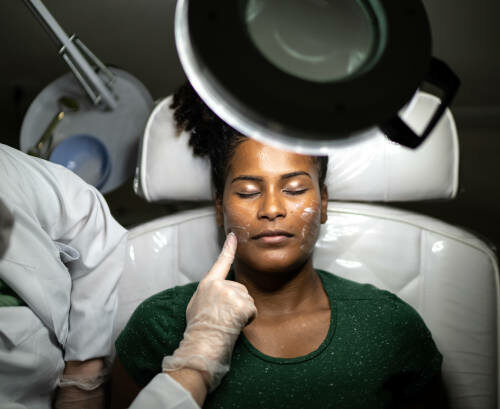
When your skincare suddenly stops delivering results, the problem may not be the products at all.
In her latest column piece, Dr Fawzia unpacks the medical science behind the skin barrier and explains why overdoing actives, treatments and exfoliation can cause skin to push back. Drawing on her clinical experience, she shares how restoring balance – not adding more – is often the key to healthier, more responsive skin. Many patients arrive in my consulting room with the same concern: ‘My skincare used to work – and suddenly, it doesn’t.’
There is often an assumption that the skin has become ‘resistant’, that products have failed, or that stronger actives are needed. From a medical perspective, this is rarely the case.
More often, the issue lies not in the skincare but in the skin barrier.

Understanding the skin barrier: Your skin’s first line of defence
The skin barrier is a complex physiological system designed to protect us from environmental stress, pathogens and excessive water loss. When intact, it allows hydration to be retained, active ingredients to be tolerated, and treatments to deliver consistent results.
However, when the barrier becomes compromised – through over-exfoliation, excessive actives, frequent treatments, environmental exposure, or inadequate recovery – the skin shifts into a defensive state.
At this point, progress stalls.
Common signs that the barrier is under strain
Clinically, a stressed barrier often presents subtly at first. Patients may notice:
- Stinging or burning from products that were previously well-tolerated
- Persistent redness or flushing
- Sudden breakouts despite ‘good’ skincare
- A tight, hot, or inflamed sensation
- Diminishing results from professional treatments
These symptoms are frequently misinterpreted as a need for escalation. In reality, they are signals that the skin’s tolerance threshold has been exceeded.
Why is more not better in skin health
In medical aesthetics, we are trained to respect the principle of controlled stimulation. Skin improves only when stimulation is matched with adequate recovery.
When stimulation exceeds the skin’s capacity to repair, inflammation increases, barrier function deteriorates and results regress.
True skin improvement depends on:
- Barrier integrity
- Appropriate treatment intervals
- Individualised active selection
- Ongoing clinical observation
This is why aggressive protocols often produce short-term changes followed by long-term instability.
Restoring skin responsiveness
When the barrier is supported and allowed to recover, the skin’s behaviour changes measurably:
- Hydration absorption improves
- Sensitivity reduces
- Active ingredients are tolerated again
- Treatment outcomes become predictable and sustainable
In many cases, progress is achieved not by adding more, but by simplifying, slowing down and stabilising.
A medical approach to skin longevity
Healthy skin is not created through force. It is built through understanding the skin’s biology, respecting its limits, and working within its natural repair mechanisms.
In my practice, the goal is never to push the skin harder – but to guide it back into a state where it can respond, recover and improve steadily over time.
Because skin does not need to be challenged to thrive.
It needs to feel safe.
Dr Fawzia Salie
Medical Aesthetic Practitioner & Trainer
Details:
Location: Aesthete by Dr Fawzia | 5 Belvedere Road, Claremont
Contact: 082 314 8294 | info@drfawzia.co.za
Website: drfawzia.co.za
Social media: @drfawzia_ | @drfawzia_skinn
Compiled by Tauhira Ajam
First published on Cape {town} etc
Also see: The truth about beauty: Debunking the most common aesthetic myths