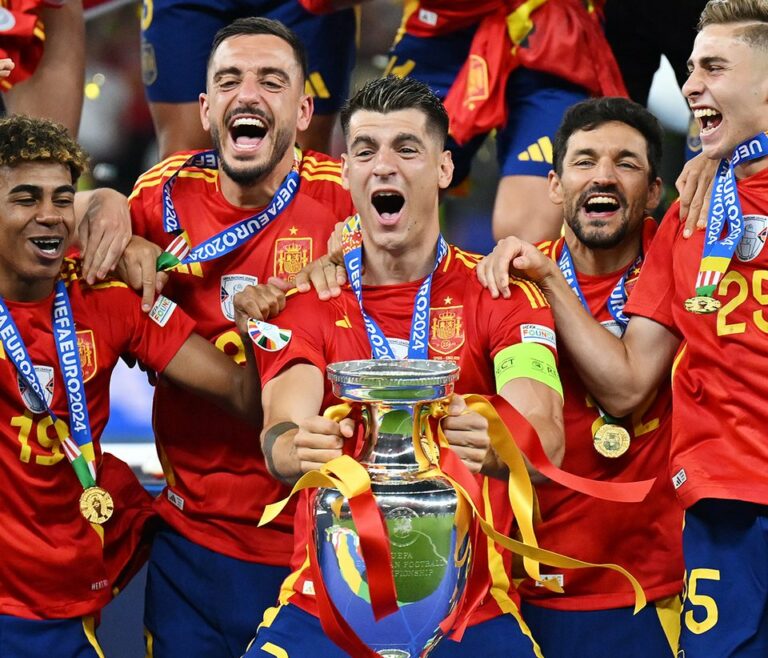
There is something about an England versus Spain fixture that always feels bigger than just another international game. And now, the rivalry is set to light up the next edition of the UEFA Nations League.
Thursday’s draw in Brussels confirmed that England and Spain will share Group A3 in the 2026/27 UEFA Nations League, ensuring that two of Europe’s heavyweights will clash once again on the international stage.
For many fans, the fixture will immediately bring back memories of Euro 2024, where Spain edged England in the final. Spain have also tasted recent Nations League success, lifting the trophy in 2023 before losing last year’s final to Portugal on penalties. England, now under Thomas Tuchel, will be eager to flip the script.
Read more: Arsenal stumble at Brentford as title race tightens
A group packed with pedigree
Group A3 is far from a two-team affair. Alongside Spain and England are Croatia, beaten finalists in 2023, and the Czech Republic. It is a section filled with tournament experience and tactical discipline, the kind of group where every point will matter.
Matches will be played home and away between September and November this year. The format remains familiar. The top two teams in each of the four League A groups will move on to the quarterfinals in March 2027. From there, four teams will advance to the finals in June 2027, with one of the qualified nations expected to host.
With the 2026 FIFA World Cup already concluded by then, the Nations League will become Europe’s main international focus before attention shifts toward Euro 2028 qualifying.
Read more: Former FIFA boss Sepp Blatter backs calls for fans to skip the US World Cup
Other blockbuster clashes confirmed
The draw did not disappoint elsewhere.
Group A1 has thrown up a classic European rivalry between France and Italy, with Belgium and Turkey completing the section. France won the competition in 2021 and reached the semifinals last year, while Italy remain perennial contenders.
Group A2 features Germany and the Netherlands, renewing one of football’s most historic rivalries. They are joined by Serbia and Greece.
Reigning champions Portugal, who also won the inaugural edition in 2019, will compete in Group A4 alongside Denmark, Norway and Wales.
Full draw overview
Here is how the groups are structured across the leagues:
League A
Group A1: France, Italy, Belgium, Turkey
Group A2: Germany, Netherlands, Serbia, Greece
Group A3: Spain, Croatia, England, Czech Republic
Group A4: Portugal, Denmark, Norway, Wales
League B
Group B1: Scotland, Switzerland, Slovenia, North Macedonia
Group B2: Hungary, Ukraine, Georgia, Northern Ireland
Group B3: Israel, Austria, Republic of Ireland, Kosovo
Group B4: Poland, Bosnia and Herzegovina, Romania, Sweden
League C
Group C1: Albania, Finland, Belarus, San Marino
Group C2: Montenegro, Armenia, Cyprus, Latvia or Gibraltar
Group C3: Kazakhstan, Slovakia, Faroe Islands, Moldova
Group C4: Iceland, Bulgaria, Estonia, Luxembourg or Malta
League D
Group D1: Gibraltar or Latvia, Malta or Luxembourg, Andorra
Group D2: Lithuania, Azerbaijan, Liechtenstein
Latvia and Gibraltar, as well as Luxembourg and Malta, will meet in two-legged play-off ties in March 2026 to determine final league placements.
A competition finding its identity
When the Nations League was first introduced, some critics questioned its purpose. But over the years it has carved out its own identity, offering meaningful competitive matches instead of international friendlies.
For teams like England, who are often judged by major tournament success, this competition presents another opportunity to build momentum and silverware credentials. For Spain, it is a chance to reinforce their dominance in European football.
One thing is certain. When England and Spain step onto the pitch later this year, it will not feel like just another group game.
The groups are set for the 2026/27 UEFA #NationsLeague ✅#SSFootball pic.twitter.com/G7RReX23Wv
— SuperSport Football ⚽️ (@SSFootball) February 12, 2026
Read more: World Cup trophy arrives in South Africa as Ramaphosa and McKenzie welcome global spotlight
Source: SuperSport
Featured Image Source: UEFA Euro on X
For more sports news and updates check out: soccermag and africapicks